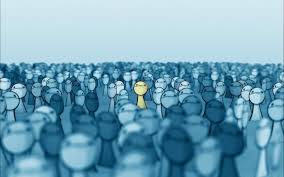
As time passes, humans will and always have drastically increased their population by huge numbers. There have been wars fought, viruses and breakdowns happened but nothing stopped people from overpopulating at the end. So, if the population increases, we should become less lonely. Being crowded is a solution to loneliness. Or is it?
The term “Crowded Loneliness” was found by Robert Weiss in 1973 and he mainly focused on conceptualizing loneliness related to isolation. However, the term he founded was completely the opposite of the mindset he defended. To understand what crowded loneliness really is we have to dig deeper on the background of the real-life examples. Especially on modern times, people tend to be more isolated regardless of their social situations. Some are living in a megacity, in a stream of people but still feel and are lonely. The main reason to that is being introverted and not talking to people or exchanging any conversation at all. I personally am not surprised by The Turkish Language Association picking the “Crowded Loneliness” as the word of the year. My view is mostly dependent on our country’s current socio-economical state. People are sorrowful in our downfall, apparently losing interest in even simple communications which overall leads to us being lonely in a crowd or community. TDK said. “In 2024, there has been an increase in studies showing that individuals feel isolated even within crowds.” Which also supports my claim. Yes, crowded loneliness as a term was found in 1973. However, it was there since the great depression. It has always affected our lives negatively and always will until us, the humans go extinct.
Nevertheless, there are various solutions for crowded loneliness such as building genuine connections, engaging in team/community activities, engaging in random kindness, creating routines for connections and practice vulnerability can be tried in the course of therapy or talking to close friends. We also can try different approaches such as limiting digital distractions or creating intentional free time. If actions like these are committed by a large group, we easily can overcome the difficulties of depression, loneliness and negative isolation.
In conclusion, “crowded loneliness” is a paradox that reflects the growing disconnect in our increasingly populated and fast-paced world. Despite the advancements in communication and the dense proximity of individuals in settings, many still grapple with profound isolation. This phenomenon (which likely will not be just a phenomenon in the future) is deeply rooted in societal and personal factors, including socio-economic challenges, shifts in communication norms, and individual tendencies toward introversion or detachment. However, this does not mean the issue is insurmountable. By fostering genuine connections, participating in community activities, and adopting mindful practices, individuals and communities can combat the effects of crowded loneliness. Addressing this challenge requires collective effort, empathy, and a commitment to meaningful engagement, proving that even in the most crowded of worlds, connection and fulfilment are still within reach.