
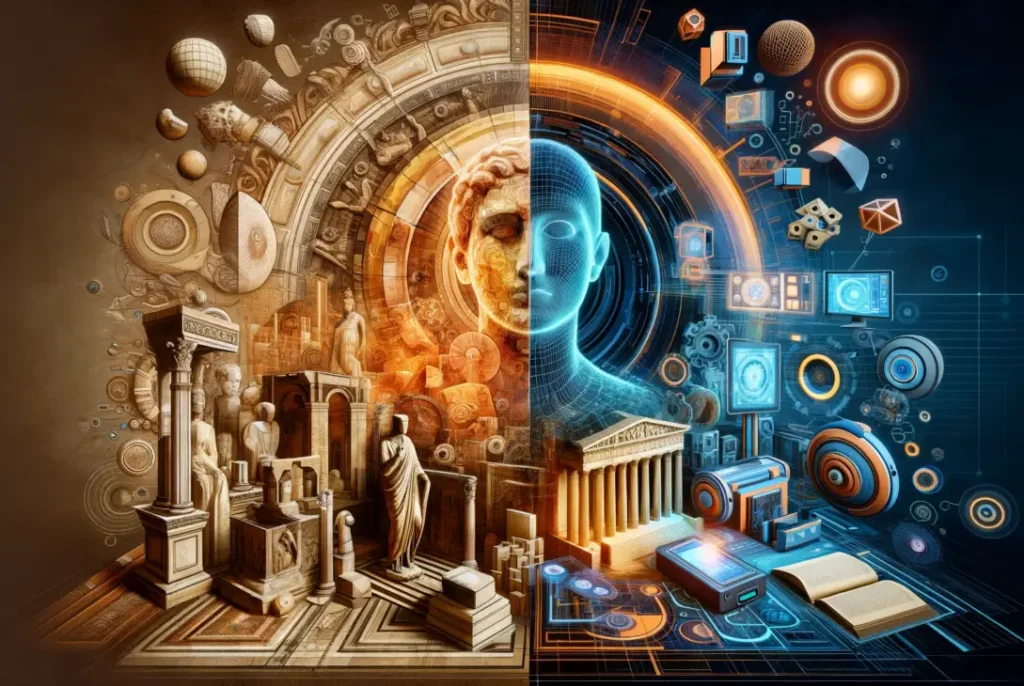
Technological advancements have facilitated many people’s way of life. However, there has been a concern about whether this rapid development in technology can cause traditional cultures to fade away. Some people think that modernisation is happening at the cost of cultures and traditions, and both traditions and innovations cannot exist simultaneously. I strongly disagree with this idea and believe that both technology and traditional culture can coexist and even symbiotically support each other.
When we look at some leading countries in the field of technology, we can see that they can both embrace innovations and preserve their cultural heritage. One of these countries is Japan where machinery is so prevalent. In Kyoto, one of the largest cities of Japan, the harmony of technology and heritage can be observed. Ancient temples and shrines coexist with advanced transportation systems like the Shinkansen (bullet trains). Despite being a modern city, Kyoto hosts several traditional festivals that are held annually like the Gion Matsuri festival, which has been held for thousands of years. This demonstrates that Japan both preserves its culture and advances in technology.
Technology has indeed changed how we live and interact with the world. The most affected groups are inevitably the younger age groups. Children mostly prefer digital entertainment rather than the traditional forms such as folk music. Furthermore, the indigenous languages that people use become substituted by the global languages, English most often, to communicate online or for other purposes. These examples can make people feel that technology is causing our traditional ways of life to disappear. On the contrary, it can provide good platforms to perpetuate traditions.
It is possible for people to share their heritage and celebrate it with a wide audience via social media platforms. Moreover, online videos and apps can teach traditional recipes or endangered languages. In order to help people experience their cultural history in a more immersive manner, virtual reality is being used to recreate ancient landmarks.
In conclusion, the key lies in finding a balance. It is imperative for communities to embrace technology while preserving their traditions at the same time. It is possible to create a world where modernisation and tradition can coexist if this can be sustained.